Fungal Remediation
Mushrooms Growing From a Wood Ceiling: What a Torrance Inspection Revealed
A Torrance inspection documented fungal fruiting bodies at a wooden ceiling joint, water staining and a 30.8% moisture reading. Learn why source investigation, wood assessment and verified drying matter before repairs.
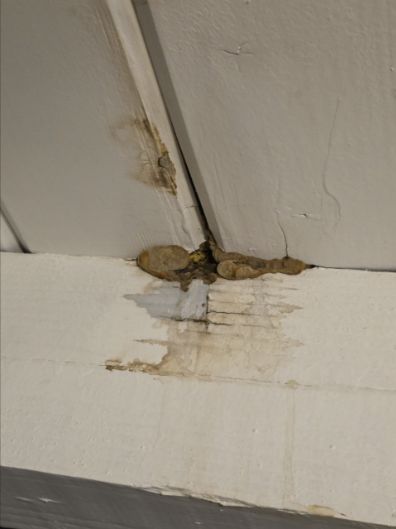
Fungal growth, staining and peeling paint at the exposed beam-to-ceiling joint during the Torrance inspection.
What You'll Learn in This Article
- Fruiting bodies at a wood ceiling joint warrant investigation of moisture and concealed wood condition.
- The inspector recorded a 30.8% wood-mode reading and a cooler thermal pattern; the leak source remained unconfirmed.
- Controlled remediation, measured drying, and documented moisture verification are required before any rebuild to avoid recurrence.
- Confirm source correction, cleaning, wood condition and documented drying before closing the assembly.
Inspection snapshot — ceiling joint (hero)
What we found on Nov 18, 2026 (Torrance bedroom)
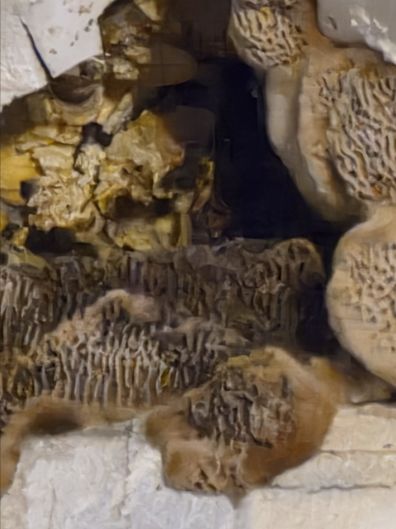
This article summarizes an inspection performed on Nov 18, 2026 in Torrance where fungal fruiting bodies were observed emerging from the junction of an exposed beam and a wood ceiling. Visible signs included water staining, peeling paint, and active fruiting structures at the joint. A handheld wood moisture meter recorded 30.8% at the affected surface. Thermal imaging showed a localized cold anomaly above the ceiling, suggesting a potential roof penetration or other leak path above—one possible suspect is a solar-panel mounting bracket, though that pathway had not been opened or confirmed at the time of inspection.
This was an inspection-only engagement. No species identification, definitive structural diagnosis, repair work, or final reconstruction was completed during this visit. The purpose of the visit was to document conditions, map moisture, and recommend a controlled remediation and drying sequence before any rebuild is considered.
Close-up: fungal fruiting bodies
What the measurements told us (and what they don’t)
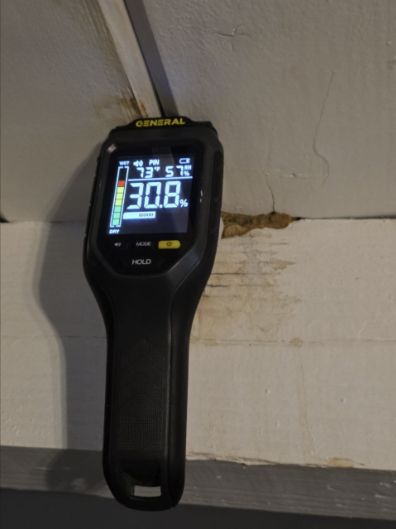
The inspector recorded a 30.8% reading in wood mode at the affected location. This supports further moisture investigation, but a single reading cannot establish how long the material has been wet or the condition of the entire ceiling. Thermal imaging showed a cooler area at the junction; temperature differences guide investigation but do not independently prove moisture or identify a leak. Meter settings, material and comparison readings matter. Neither tool identifies the fungal species or remaining structural capacity.
The inspection report recommended coordination with a qualified roofing or solar professional to investigate the suspected mounting penetration and controlled access to evaluate concealed materials. The roof entry point and extent of any concealed damage still require confirmation.
Moisture reading documented
Immediate steps taken and recommended next actions
- Document conditions with photos (wide, close-up, and contextual shots) and record moisture readings with the meter visible.
- Limit disturbance of the area to reduce spore spread—avoid sweeping or using forced-air HVAC until containment is planned.
- Isolate the room if practical and schedule targeted access above the ceiling (attic/roof) with a roofing/solar specialist to inspect suspected penetration points.
- Plan selective, controlled exploratory openings only after source-team coordination to avoid creating larger damaged areas.
- Arrange professional containment, drying and moisture logging before any reconstruction or cosmetic repairs.
Controlled remediation sequence recommended (high level)
1. Source investigation
Coordinate with a qualified roofing or solar professional to investigate the roof and mounting penetrations above the affected area. Confirm or rule out the suspected bracket and repair the actual water source; coordinate the order of roof work and controlled interior access for the site conditions.
2. Targeted exploratory access
Open the smallest practical access above/below the affected zone to confirm extent and avoid unnecessary demo. Photo- and meter-document any exposed framing or insulation.
3. Containment and selective removal
Establish appropriate containment and dust control before disturbing affected materials. Define removal boundaries after assessing concealed conditions. Evaluate affected wood, including suspected structural damage, with qualified professionals as needed; visible appearance alone does not determine what can remain.
4. Measured drying and monitoring
Use suitable drying equipment and document readings at defined locations against project-specific material criteria and reference readings. Thermal images may supplement the record; a temperature pattern alone is not proof of dryness.
5. Clearance and reconstruction planning
Verify source correction, completion of cleaning, material condition and documented drying before closing the assembly. Obtain any necessary structural assessment and independent verification appropriate to the project. Dryness alone does not establish that previously damaged wood is structurally sound.
Why we delay reconstruction until verified dry
Rebuilding over wet wood or without confirming the leak source risks recurrence and expands repair scope. The presence of fruiting bodies shows reproduction—removal plus measured drying and source repair are required to make a rebuild defensible.
Urgency note
A >30% wood moisture reading with visible fruiting bodies is a red flag. Do not leave the condition unaddressed while you wait for slow fixes—document, isolate, and start a coordinated investigation quickly to limit hidden spread.
Related resources
FAQ
How fast can fungal fruiting bodies appear?
Timing varies with the organism, substrate and moisture history. The appearance of fruiting bodies cannot reliably date the leak. This inspection did not establish when the water intrusion began.
Can I wait a few days before investigating?
With readings as high as 30.8% and visible fruiting bodies, waiting risks spread and hidden damage. At minimum document conditions, limit disturbance, and schedule a coordinated investigation within days.
Will insurance likely cover this rain-related damage?
Coverage depends on the policy and whether the loss is sudden or from long-term neglect. Document dates, meter logs, photos, and any source repairs; share them with your adjuster and ask for written guidance from the insurer.
Need a same-day inspection and drying plan?
Fast inspection and measured drying reduce mold risk, hidden damage, and repair scope. We coordinate source investigation with roofing and solar specialists as needed.
Call URSA-PRO Restoration — (213) 460-4929